Early adaptor, hippy, psychonaut or just a little crazy?
30 days of microdosing was my first experiment and set in motion the 30 day format. It was the perfect project to create a journaling habit, explore my writing style and to start doing instead of dreaming. At this time, April 2021, microdosing and psychedelics were yet to hit their popularity tipping point.
For the mainstream audience ‘magic mushrooms’ still had a slightly negative reputation. My interest piqued when I came across an article about how microdosing was becoming a trend in Silicon Valley: framing the use of psilocybin in small doses, as supplementing rather than doing drugs.
Technically an alcoholic, and probably a junkie…
Although I grew up in the north of the Netherlands, I have lived in Amsterdam for over 10 years, which made me quite liberal in a lot of aspects in life. During my student life, and probably for a little too long after, I have occasionally dabbled in recreational drugs. It never seemed to affect my day to day life, so it never seemed troubling to me. Now, when you combine this with the shifting values in Amsterdam, where no one seems to be shocked when little baggies and keys are being pulled out on a regular Friday night, it’s a slippery slope into a bad habit. I am all for a ‘to each their own’ approach, but somewhere down the line, we, privileged people in any city doing recreational drugs, forgot that ownership and consequences are also part of the deal. Boy, did I manage to stick my head in the sand on that one, all while the solution was right under my nose. It’s all well and good to set your intentions, meditate and manifest your way into a holistic lifestyle, but when you’re starting to dip your keys to offset your alcohol levels, your body kind of shifts from temple to dumpster. If at this point you feel offended or called out, this feeling too shall pass. It’s not personal, but it helps to have your nose in the air and to read between the lines.
I learned the hard way that my body and soul don’t handle comedowns well and that being hungover takes up at least 3 days of feeling depressed and lost. My weekly Huberman Lab update has also made it harder to keep ignoring the self sabotage I created with alcohol and drugs. More on this in my 30 Days Sober project, which ended up lasting about 4 - 5 months.
While I like to believe my values are relatively traditional, for outsiders, I am probably considered really open minded. My experience with drugs and my inquisitive nature now awakened the experimental journalist in me: What could microdosing do for me, creatively and mentally? After researching what goes into recreational drugs, did mushrooms really seem that bad? There was only one way to find out.
Before I started the 30 days of microdosing experiment, I too was full of assumptions on psychedelics and particularly mushrooms. The “I heard someone high on mushrooms jumped off a building because they thought they could fly” tale gets told an awful lot, probably by people who have never even experienced psilocybin or psychedelics.
Now, I don’t believe there is such a thing as ‘a bad trip’. Before you come at me with your worst story, let me add some nuance: I believe the mushroom will give you what you need, whether that’s a mind altering realisation or an ass whooping of your ego. When using psychedelics, your set and settings will heavily influence your experience and there is a big difference though, between using psychedelics in a therapeutic or holistic setting, or in more of a ‘let’s look for gnomes in the park with the homies’ kind of trip.
Back to the Silicon Valley article: it summed up some pretty convincing pro’s, and the cons didn't seem that bad. I dug a little deeper and found a few more articles and websites that educated me about psilocybin, dosage, strains and how to cultivate mushrooms. Going down the Psilocybin rabbit hole made me realise how incredibly negligent I had been when it came to recreational drugs: it seemed I had a nose for obsessively researching anything, but mostly when the outcome was health-oriented or in my favour.
Saying there’s no such thing as a bad trip doesn't mean mushrooms are for everyone. Mental illness, or sensitivity to psychoses is probably a good enough reason to steer clear of them, or to at least speak to a psychiatrist before going on a journey: with great power comes great responsibilities.
Let's not get carried away though, sometimes you have to take a calculated risk and live a little, what's the worst that could happen?
30 Day Habit
Are there even any cons?
Time to put myself at ease and have the pros outweigh the cons. I set out to answer all my questions, invalidate my concerns and clarify my goals. Digging in showed me, I indeed had mostly assumptions based on no facts whatsoever. Now, that doesn’t this experiment can’t go sideways, or that Magic mushrooms are safe for everyone, however my ego is telling me this kool aid probably tastes like lemonade. Let’s get some concerns out of the way though..
- Can I overdose on mushrooms?
- What is actually in them?
- What happens to your brain on the active substance psilocybin?
- What happens on a bad trip? (and how long does it last, and can I stop it?)
- Where can I get microdoses?
- How do you know how much mushroom to take for a microdose?
- Can you actually get into a psychosis from just one mushroom trip?
- Is microdosing illegal?
- Does one microdose actually have an effect?
Interest piqued? I’ll answer most throughout, but I’ll try to stay on topic. After microdosing I ended up going on a full dose journey, more on that life-altering experience later.
So how does psilocybin work?
Let’s start with: No, you physically do not overdose on mushrooms, not the way you would with cocaine or other methamphetamines. If you are genetically disposed to psychosis, it might not be for you though.* Here’s a concise synopsis of how psilocybin works. **
Psilocybin is a tryptamine, closely resembling serotonin (which is naturally made in the brain and body). Serotonin is a neuromodulator (changes the activity of other neurons) that regulates behaviour. By modulating neuronal excitability and plasticity you produce a net effect of satiety, mood regulation, sense of pleasure, and many more functions that impact daily life.
Psilocybin mainly binds to the serotonin 2A receptor which allows for specific types of neural circuitry to take place and last even after exposure. Serotonin 2A receptors have a lot of expression in the neocortex, responsible for understanding context, behaviour, thoughts, speech patterns, perception and sensation. There’s also a very high amount of serotonin 2A receptors in the visual cortex (which is why psilocybin triggers hallucinations). When using psilocybin, there’s a shift from the brain being more segmented (closed minded & constructed by ego) to more extensive communication and integration (more fluid and less clouded by ego). Psilocybin acts by altering the activity and connectivity across DMN-associated brain regions: psilocybin increases and diversifies functional connectivity (=positively correlated neural activity) patterns throughout the brain.
If you want to go down the rabbit hole of psilocybin first, I suggest you start here. If you’re mostly interested in microdosing, I suggest you keep reading first and spiral later ;).
* I am a psychonaut, not a medical professional, just to clarify. My science comes mostly from sources like the Huberman lab, medical journals, university websites & the world wide web.
Mushrooms or Truffles?
Back to Silicon Valley: if the tech world is getting in, then why aren’t I? I asked around to see who in my close vicinity had dabbled in mushrooms. Most of my friends didn't seem that interested, others had some experience, but more so in a festive setting. Back to the internet.
I found some website where you could order microdoses of truffles, which are legal and contain the same active compound. So, what's the difference between psychedelic mushrooms and psychedelic truffles?
In terms of psychoactive compounds, they tend to generate similar amounts of psilocybin. Fresh mushrooms contain much higher amounts of water, meaning that fresh truffles contain more psilocybin per gram. A differential point within the effects is that the magic truffle tends to have the psilocybin distributed much more evenly throughout its entire structure, which makes it an easier option if you just want to start microdose with psilocybin.
On the other hand, once dried, hallucinogenic mushrooms can lose up to 90% of their total weight, while truffles will lose up to 30%. This will result in the need for far fewer mushrooms than truffles if both are dry. Also texture wise, truffles tend to have an incredibly earthy taste and a moist, hard, nutty texture, so eating more of them did not seem like a pleasant experience. Besides, I was ready to channel some of that ‘Walter White’ energy, so growing mushrooms seemed like a fun new project that would give me something to write about as well, so why not?
Grow a pair
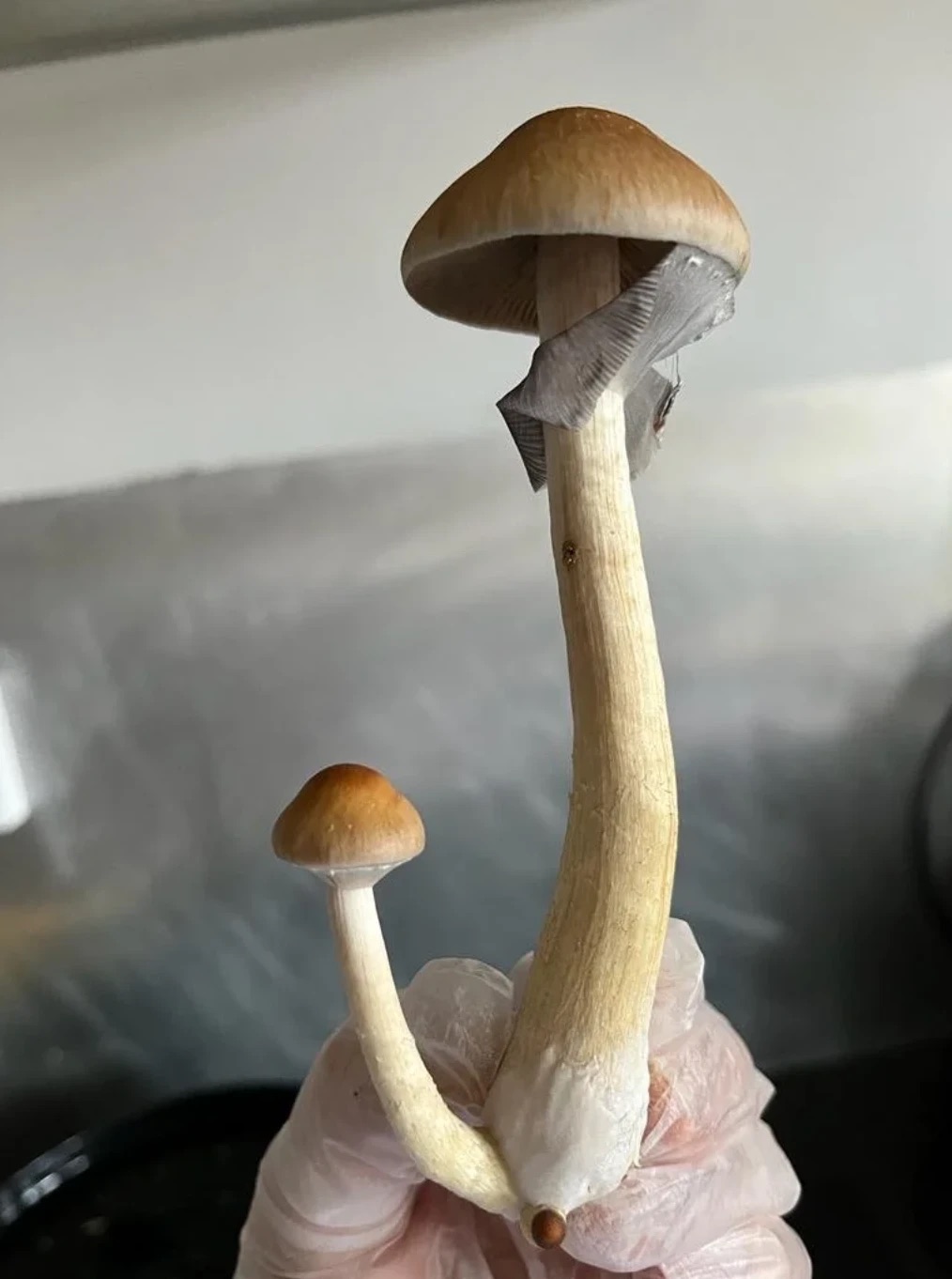
I’m a little impulsive, mostly because I somehow never seem to find my 3rd or 4th gear and head into a full sprint or complete standstill. Plenty of blogs were praising mushroom cultivation and ‘the internet said’ it was relatively easy to grow these mushrooms. Initially I wanted to go all in, and create psychedelic mushrooms from scratch, or actually magic mushroom spores. However, somewhere down the rabbit hole I started reading up on the amount of equipment needed and the likelihood of contaminations and ruined harvests. Instinctually I figured there was a high probability I would fck it up somewhere close to the finish line, so maybe save the full ‘Walter White’ mode for later and start with a mushroom grow kit. With so many smart shops around, I closed my laptop, jumped on my bike and headed over to pick up a grow kit, so I could get this pony show on the road.